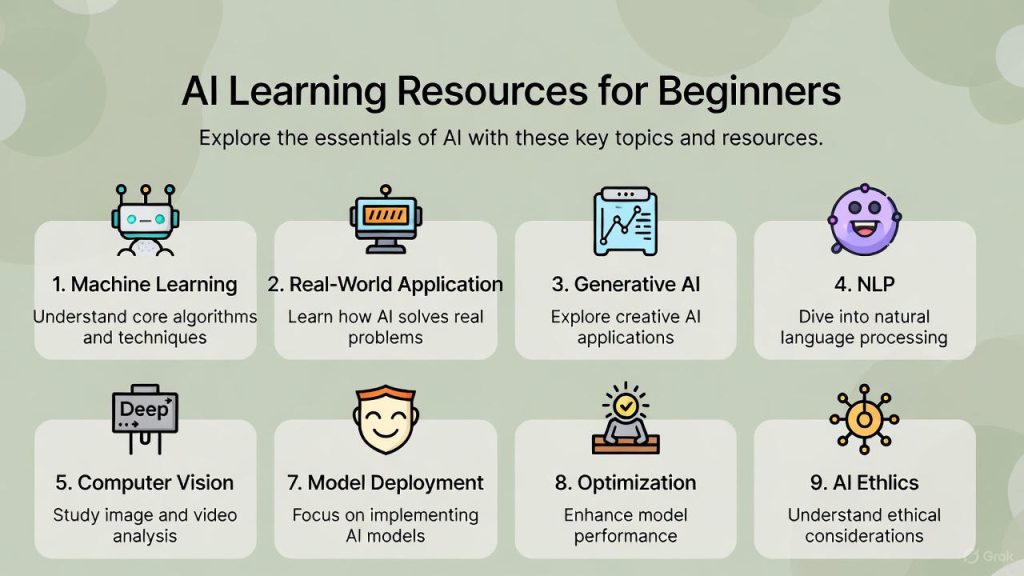
AI learning resources for beginners are in greater demand than ever, with millions signing up for introductory AI courses worldwide. As artificial intelligence shapes industries and daily life, adult learners and college students with no prior background want direct answers: Where do I start, what works, and what pitfalls should I expect in today’s fast-changing AI education landscape?
Key Takeaways
- Global enrollment in AI courses has skyrocketed, but beginners face real obstacles relating to support and course coverage.
- Most entry-level resources now focus on applied GenAI skills over theory, yet crucial topics like workflow integration and practical ethics remain under-taught.
- Learners should set realistic expectations: engagement and foundational skills improve, but measurable job outcomes and credential value evidence are limited as of 2024–2025.
- Why Interest in AI Learning for Beginners is Exploding in 2024-2025
- The Most Popular Types of AI Learning Resources for Beginners
- Real Barriers Beginners Face with AI Courses and Tutorials
- What Entry-Level AI Courses Actually Offer (and What’s Missing)
- Essential Beginner Sub-Topics Often Overlooked
- Outcome Snapshot—What Can Beginners Expect to Achieve?
- Technical Prerequisites and Getting Started Painlessly
- Data Gaps and What to Look for Next
- Frequently Asked Questions
Why Interest in AI Learning for Beginners is Exploding in 2024-2025
The landscape of AI learning resources for beginners has radically changed since early 2023. Global enrollment rates have reached record highs, driven by rising workplace automation, media exposure, and the entry of foundational models like ChatGPT into mainstream culture. In January 2024, almost 3.5 million students had taken Generative AI courses on Coursera or Udemy alone, amounting to tremendous growth in AI course participation. According to Coursera, demand for AI education now dramatically outpaces all other skill categories tracked on the platform, with a new student enrolling in a GenAI course every 10 seconds.
This unprecedented surge shows no signs of slowing. The benefits are clear: hands-on AI literacy is quickly becoming essential for career advancement and even daily digital competence. Especially for adult learners and college students starting with no programming background, these trends promise greater access—but also increased noise and uneven quality among available learning resources.
The Most Popular Types of AI Learning Resources for Beginners
Today’s AI courses for beginners cover a wide spectrum. Major formats include:
- Online video-based courses and “micro-learning” modules (Coursera, Udemy, edX, LinkedIn Learning, FutureLearn, Google, Microsoft)
- Interactive tutorials (Codecademy, DataCamp, AI4ALL, NVIDIA DLI)
- Self-paced books and “practical guides” (often old, limited to Python or basic AI concepts)
- Industry-developed certificate programs (IBM, Google, Amazon, DeepLearning.AI and Meta)
GenAI topics dominate, with providers adding over 450 new GenAI courses in 2024. That is roughly one new course released per day. According to platform rankings, 40% of Coursera’s top courses now teach AI, and—for the first time—a GenAI course claims the number one most popular course spot. Tech giants such as Google, Amazon, Meta, and NVIDIA have expanded their basic learning portals and issued highly visible, entry-level certifications.
There is a trend, too, from long theoretical lectures toward hands-on, project-based content targeting practical adoption at work. “AI for Everyone,” “Prompt Engineering Basics,” and “GenAI Tools for Productivity” sit alongside classic introductions like “Machine Learning Foundations” or “Intro to Deep Learning.”

Real Barriers Beginners Face with AI Courses and Tutorials
AI tutorials for beginners face some well-documented and honest frustrations. Chief among them:
- Lack of Instructor Support: Many platforms offer limited access to instructors, leaving students with unanswered questions and stalling progress.
- Pacing Issues: Without structured guidance or feedback, it’s easy to move too quickly and miss basics—or get stuck and abandon the resource entirely.
- Overwhelming Jargon: Even so-called “beginner” tutorials often assume some tech fluency, leaving absolute newcomers behind.
- Institutional Gaps: Research shows faculty adoption of AI lags at 14% while student adoption runs at 86%, highlighting schools’ limited support for new online learners.
These gaps mean many beginners turn to large online communities or Q&A portals for help, but uneven advice and a lack of structure increases confusion. The best resources anticipate frustration points—and actively provide pacing, support, and troubleshooting guidance, not just video lectures or check-the-box quizzes.
For an in-depth look at the international demand and adoption patterns shaping these trends, see the AI Education for Beginners – Global Growth, Barriers, and Learning Outcomes report.
What Entry-Level AI Courses Actually Offer (and What’s Missing)
Most AI courses for beginners promise video content, interactive quizzes, and a certificate of completion—sometimes an institutional badge. In 2024 alone, Coursera added 25 new entry-level certificates, growing its catalog by 33%. Major platforms now emphasize applied GenAI skills relevant to the workplace, with practical exercises focused on prompt engineering, productivity boosters, and ethical decision-making scenarios rather than dense mathematics or programming from scratch.
But course offerings remain uneven. What’s often missing:
- Competency-based skill validation or portfolio-ready sample projects
- Real-world use case walkthroughs tailored to common workplace tasks
- Deep dives into foundational math or algorithm basics for those wanting to “level up” later
- Ongoing mentorship or practice communities
Many resources promise a certificate, but tangible evidence about the career value of these credentials is sparse. As of mid-2024, there is little comparative research linking beginner AI certifications to actual job placement or salary outcomes.
Essential Beginner Sub-Topics Often Overlooked
Despite the explosion in beginner guide to AI learning resources, major teaching gaps persist. Based on a cross-analysis of top-ranked courses and a recognized lack of systematic coverage analysis, several recurring omissions stand out:
- Integrating AI into Personal Workflow: Most courses demo tools, but few show beginners how to embed GenAI into daily work (e.g., drafting, research, productivity).
- Practical AI Ethics: High-level talks on bias or fairness are common, but applied ethics—such as responsible prompt engineering and real example dilemmas—are rare in beginner tutorials.
- Math and Logic Foundations: Courses often assume basic math but rarely teach the specific skills (like logic, statistics, or problem decomposition) needed for later success in AI beyond “prompting.”
Few AI learning resources for beginners reflect on these gaps, signaling a valuable opportunity: Seek out content that emphasizes these issues, especially if you hope to build a durable, transferable understanding—not just a credential or “how-to” cookbook.
Outcome Snapshot, What Can Beginners Expect to Achieve?
What do real-world outcomes look like for newcomers who invest in the best AI books for beginners or targeted online courses?
- Skills: Expect increased familiarity with GenAI tools, prompt writing, and basic applied use cases (writing, summarizing, text analysis).
- Engagement: Initial evidence from schools using AI-powered personalized learning shows a 12% increase in student attendance, suggesting notable boosts in engagement and motivation.
- Confidence: Most report higher digital comfort, but clarity drops when advanced math or programming appears without ramp-up.
- Job Prospects: Despite rising market buzz, there is still no credible, large-scale data tying completion of entry-level AI courses to job placement or salary increases in 2024–2025.
To maximize returns, learners should treat these resources as strong starting points, not job guarantees. As professional and academic adoption accelerates, evidence-based course value should become more transparent in coming years.
Technical Prerequisites and Getting Started Painlessly
One of the biggest myths among adult learners: that you need deep programming or advanced math skills to begin. Most top beginner guide to AI learning resources now take a “no code, no math” approach, catering to newcomers. Entry-level GenAI tutorials ask only for basic computer literacy: internet navigation, email, and the ability to use common productivity tools (word processors, spreadsheets).
For “classic” AI and machine learning fundamentals, a comfort with high school math and logic thinking helps. Coding skills (Python, JavaScript) are still useful for technical track learners, but vast numbers of practical courses now focus on low-barrier applied skills—prompt crafting, template building, and safe tool experimentation. In 2024, course enrollment data confirms the shift from theoretical understanding toward practical application at the earliest stage.
Data Gaps and What to Look for Next
While hard data exists on enrollment numbers, course growth, and student adoption, there are still serious gaps when selecting AI learning resources for beginners:
- Little public information on pricing tiers, true time requirements, or in-depth review of book recommendations (especially post-2022 texts).
- No definitive evidence on which certifications or resources yield the best career outcomes.
- Almost no consistent reporting on technical prerequisites or the comparative quality of peer/instructor support.
Practical advice: When choosing a course or book, look for transparent sample modules, verified student testimonials, or active community forums. Until the industry provides better consumer protections and quality signals, prioritize resources with clear practical exercises, flexible pace, and responsive feedback mechanisms over vague promises of job-readiness.

Frequently Asked Questions
Do I need programming skills to start with AI learning resources for beginners?
No. Many entry-level courses and tutorials are designed for complete novices. As of 2024, basic computer skills are enough for most introductory GenAI content.
Are AI certificates from platforms like Coursera or Udemy valuable for jobs?
The market is still evolving. While these certificates show initiative and relevant skills, there is little definitive evidence tying them to specific job placements or salary increases. Use them as conversation starters and personal milestones.
How much math do I need for beginner AI courses?
Minimal. For prompt engineering, workflow tools, and many practical GenAI applications, high school mathematics and logical thinking are sufficient. More technical tracks may require statistics or programming later on.
What’s the biggest mistake first-time AI learners make?
Jumping into advanced resources too fast, or choosing courses without support/community features. Start with structured, well-reviewed beginner content and focus on applied practice.
How do I pick the right AI book or course as a beginner?
Seek resources that offer actionable exercises, evidence of recent updates (post-2022), clear feedback channels, and practical examples. Avoid courses heavy on theory or jargon if you want hands-on skills first.